Ekta Setu
Connect with your Sangh & Family from one simple hub.
The Original Jain Panchang — Trusted by the Jain Community Since 2013
A detailed Jain Calendar and daily timing companion for Tithi, Navkarshi Times, Choghadiya, Hora, Nakshatra, Kalyanak, Kamdi Kal, Pachakkhan, Shubh Yog and more — with location-aware timings and an interface made for everyday use.


Jain Panchang 2026.6 adds the Jain Business Directory (JBD), a community-focused discovery layer for Jain businesses, entrepreneurs, professionals, services and products.
Searching and browsing the Jain Business Directory is open without an account. JP ID is required only for account-linked actions such as registering a business, claiming an existing business or managing a listing. The core Jain Panchang and Jain Calendar also remain usable without JP ID.
Business and product submissions are moderated. Listings can include useful business information, photos and optional location details, while users can report information that may be incorrect, outdated or inappropriate for review. Business owners can use JP ID to maintain account-linked listing information.
The optional AI description writer can help prepare a draft business or product description from information supplied by the user. The generated wording is not automatically published. The user reviews the draft and explicitly decides whether to use it.

Your Panchang now brings Jain Daily Details, Holidays, My Reminders, Family Alerts and Sangh Updates together — while keeping the Jain Calendar clear and familiar.
Connect with your Sangh & Family from one simple hub.
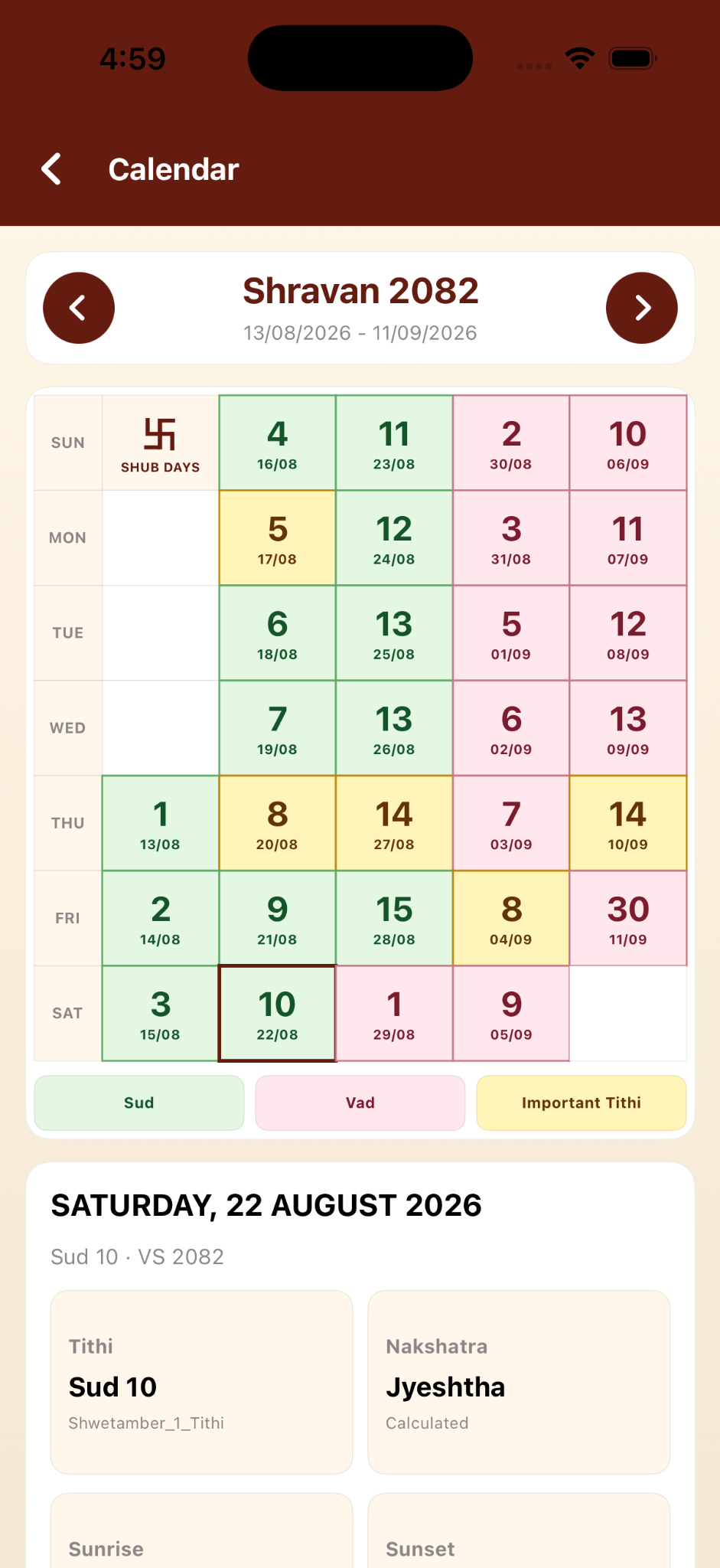
Browse month-wise Jain day information with Tithi, Paksha, Jain month and relevant details.
See National, Government, Bank and State/UT holidays alongside your calendar.
Create private one-time or yearly reminders stored only on your device.
Share family events and reminders with approved members using JP ID invitations.
Join an approved Sangh and receive official published events and updates.
These are actual app screens, not concept mock-ups. Browse the Jain Calendar, daily dashboard, Nakshatra, Kshay/Vruddhi, Hora, Kamdi Kal and Shubh Yog interfaces at a glance.


Current Android product screens from the Google Play presentation — including light/dark home, Jain Calendar, Navkarshi and specialist views.


Choose a warm light interface or a focused dark interface. Both keep the same information hierarchy so switching theme never changes how you use the Panchang.
Warm cream surfaces, maroon typography and high-contrast white cards keep dense Panchang information readable.
Deep charcoal surfaces with warm gold outlines reduce glare while preserving the same familiar navigation.
Every feature is designed around a real daily question — today’s Tithi, the right Navkarshi time, the running Choghadiya, the next Kalyanak, a Hora period, a Nakshatra change or a special calendar exception.

Browse Jain months and daily Tithi in a calendar built around Sud/Vad, important Tithis and religious context.
Jain Calendar
See location-based sunrise and Navkarshi timings so a Jain-specific daily observance is available exactly where you need it.
Navkarshi Times
Check the current and upcoming Choghadiya periods with simple day/night and date navigation.
Choghadiya
View day and night Hora periods for the selected date and location as an optional traditional timing reference.
Hora
See calculated Nakshatra periods, running status and Panchak / Vincho reference from one screen.
Nakshatra
Keep important Tirthankar Kalyanak dates visible alongside the Panchang and calendar.
Kalyanak
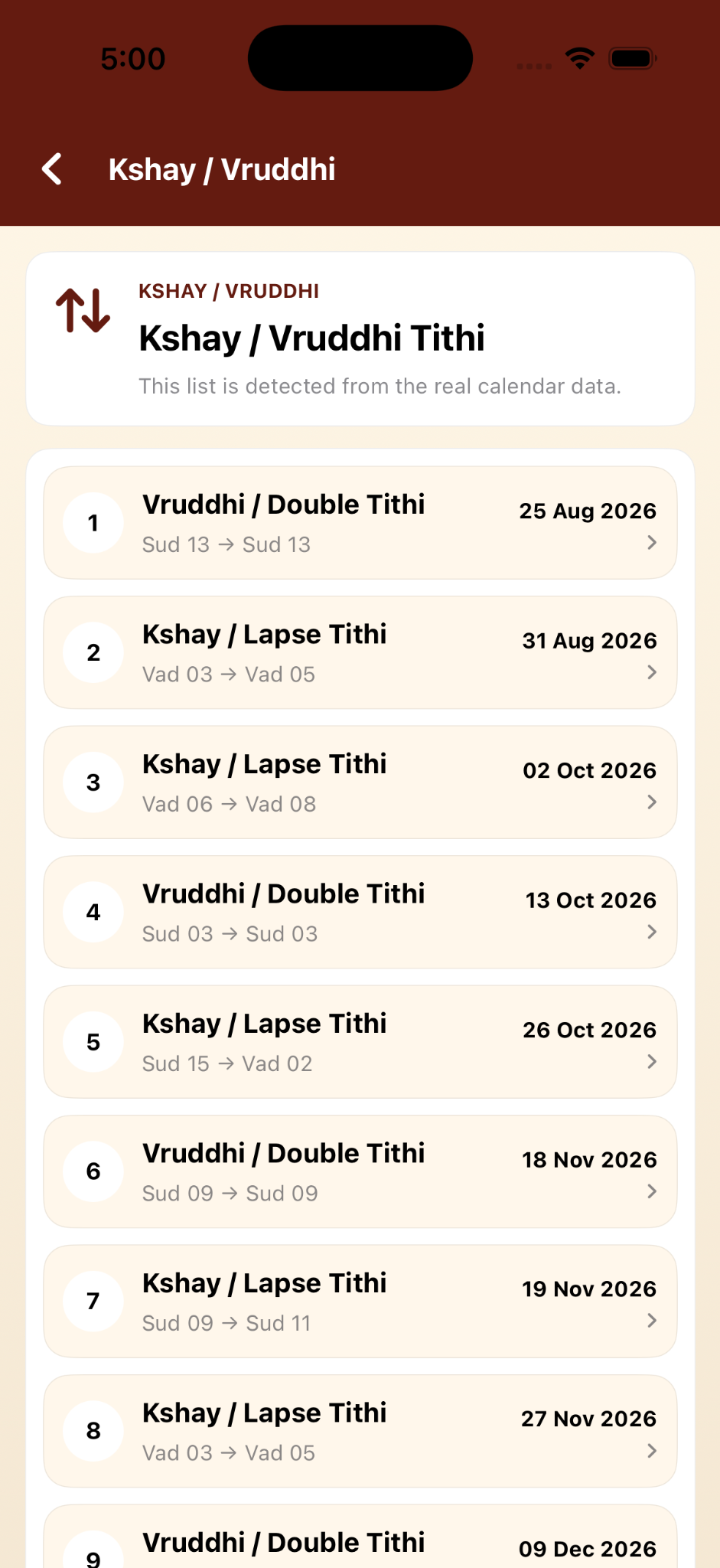
Quickly identify repeated or lapsed Tithi situations that can otherwise be confusing in a normal calendar.
Tithi Exceptions
Consult traditional Ghadi-based morning and evening time bands with sunrise and sunset for the selected location.
Kamdi Kal
Calculate upcoming Guru Pushya, Ravi Pushya, Amrit Siddhi and Sarvartha Siddhi combinations.
Muhurat
Keep commonly used Pachakkhan audio close at hand for convenient daily listening and practice.
Pachakkhan
Open Jain reading and reference material through the E-Book section inside the app.
Knowledge
Optional supporting utilities are available without taking focus away from the core Jain Panchang.
UtilitiesJain Panchang is most useful when the numbers come with context. These guides explain what the calendar terms mean, why they are consulted and where a timing system is Jain-specific versus a broader traditional reference.
Tithi gives many Jain observances their calendar identity. Learn Sud/Vad, sunrise relevance and why a Tithi may repeat or lapse.
Read the full guide →Navkarshi is Jain-specific in everyday use and tied to local sunrise, which is why location-aware timing matters.
Read the full guide →Choghadiya is not uniquely Jain doctrine. Many Jain families still consult it as a practical secondary time reference.
Read the full guide →Hora is another broader traditional timing system. The app includes it as an optional reference while keeping Jain observance categories distinct.
Read the full guide →A Jain date is often remembered as a Tithi — not merely as a number on the Gregorian calendar. Fasts, festivals, Kalyanaks and recurring religious observances are tied to lunar days, which is why Jain Panchang gives Tithi, Paksha and Jain month visual priority.
Tithi does not follow a fixed 24-hour clock. It can change during the civil day, which is also why Kshay and Vruddhi situations need proper explanation rather than being treated as errors.
Navkarshi is one of the most distinctly Jain daily timing needs in the app. A commonly followed reference places Navkarshi two Ghadi — about 48 minutes — after sunrise. Because sunrise changes by city, date and season, the clock time must be location-aware.
Jain Panchang brings sunrise, sunset and the derived daily time into one screen. Religious observance itself should follow the user’s tradition and Guru guidance.
Choghadiya divides day and night into traditional periods such as Shubh, Labh, Amrit, Char, Rog, Kaal and Udveg. It is a broader Indic timing system — not a uniquely Jain religious rule. Many Jain families nevertheless consult it for practical scheduling, so the app makes it easy to see NOW and NEXT while keeping its role clear.
The wheel used in the app makes the seven period names easy to recognize. Local sunrise and sunset determine the actual clock intervals.
Dedicated screens keep advanced information readable. Instead of squeezing every calculation into one crowded table, each topic gets its own focused experience.


From sunrise to evening, different features become useful at different moments. Jain Panchang keeps them together instead of making you search across separate calendars and websites.
Check sunrise & Jain date
Know the local Navkarshi time
Use Tithi, Choghadiya & Hora
See Kalyanak, Muhurat & calendar
Review sunset, night Hora & timings
Short explanations for the words that appear throughout the Jain Calendar and daily timing screens.
Clear answers about Jain Tithi, Navkarshi Times, Choghadiya, Hora, Kalyanak and the app itself.
Jain Panchang is a Jain Calendar and daily timing app that brings Tithi, Jain month, Navkarshi Times, sunrise/sunset, Choghadiya, Hora, Nakshatra, Kalyanak, Kshay/Vruddhi, Kamdi Kal, Shubh Yog and other references into one Android and iOS experience.
Many Jain fasts, festivals, Kalyanaks and recurring religious observances are identified by lunar Tithi. The civil date is still useful, but the Tithi often carries the religious identity of the day.
Navkarshi is a Jain sunrise-linked time reference. A common convention places it two Ghadi — about 48 minutes — after local sunrise. Users should follow the rules of their own tradition for actual observance.
Yes. Because it is derived from local sunrise, the clock time changes by date and location.
No. Choghadiya is a broader traditional Indic timing system. Many Jain families consult it as a practical secondary reference, but it should not be confused with core Jain doctrine or Tithi-based observance.
Hora is also a broader traditional planetary-hour system rather than a uniquely Jain rule. Jain Panchang includes it as an optional reference for users who already consult it.
They are sunrise-based calendar exceptions. A Tithi can be repeated across two consecutive sunrises (Vruddhi) or begin and end between sunrises so that it is absent at sunrise (Kshay).
The five commonly recognized Kalyanaks are Garbha, Janma, Diksha, Keval Gyan and Moksha/Nirvana.
Yes. The app includes both light and dark presentation while keeping the same familiar dashboard structure.
Yes. Separate official links are provided for Google Play and the Apple App Store.
The app supports available sect/community Panchang selections. The exact datasets available can evolve over time.
Core Panchang functions are designed for regular app use without needing a daily web service. Features that open online content, such as some reading resources, may require connectivity.
Jain Panchang traces its app journey to 2013 and is presented here as The Original Jain Panchang — Trusted by the Jain Community Since 2013.
No. Jain Panchang is a practical reference. For formal religious observance, vows, festival decisions and tradition-specific rules, follow the Panchang and guidance accepted by your Guru, Sangh or sect.
Jain Panchang has served the Jain community since 2013 as a practical digital companion for Jain Calendar information. Users come to the app for Jain Tithi, Jain month, Paksha/Sud-Vad context, sunrise and sunset, Navkarshi Times, Choghadiya, Hora, Nakshatra, Kalyanak, Kshay/Vruddhi Tithi, Kamdi Kal, Pacchakhan resources and other day-to-day references. The website keeps detailed guides for these subjects so a search for Jain Calendar, Jain Tithi today, Navkarshi time or a specialist Jain Panchang term can lead to explanatory content rather than a thin download page.
The app also recognizes that Jain traditions are not identical in every place or sect. Calendar interpretation, vrata rules and observance practices may vary across Shwetambar, Digambar, Sthanakwasi, gachh traditions and local Sanghs. Jain Panchang is therefore a practical reference, not a replacement for the Panchang or guidance accepted by a user’s Guru, Sangh or tradition. Where a subject can vary, our guides aim to explain the concept without presenting one local practice as universal Jain doctrine.
A Gregorian date tells only part of the story for many Jain observances. Tithi gives the lunar-day context used for numerous fasts, festivals, Kalyanaks and recurring religious occasions. Sunrise can also matter when determining how a Tithi is represented for the day, and sunrise-linked references such as Navkarshi naturally change with date and location. The Jain Calendar section explains Tithi, Jain month, Kshay and Vruddhi, and related concepts in detail, while separate Navkarshi, Choghadiya, Hora and Nakshatra pages give users focused reference material.
These traditional-reference features remain the core of Jain Panchang. Version 2026.6 does not place an account wall in front of the Jain Calendar. A user who wants to check the Panchang should be able to do that without first creating a social profile or business account.
Ekta Setu adds optional community tools around the calendar. Jain Family provides an approved private membership context for shared family events and reminders. Jain Sangh provides a separate community context for Sangh events and updates. Personal reminders remain separate again. Keeping these three sources distinct helps users understand whether an event belongs only to them, to an approved Family, or to a Sangh.
Supported event reminders use a prominent alarm-style experience with Snooze and Dismiss actions rather than relying only on a small passive notification. Shared events can also be synchronized so changes in Family or Sangh membership and event information can be reconciled on the device. The event tools help people remember what matters; they do not determine the religious validity of a Jain Tithi or observance.
JP ID is the account layer used where Jain Panchang needs persistent identity — for example, approved Family membership, certain Sangh interactions, recovery, or ownership/management actions in JBD. JP ID is not required for ordinary Jain Panchang and Jain Calendar use, and it is not required simply to search the Jain Business Directory. It is a technical account identifier, not a certificate of sect, religious status or community standing.
The new Jain Business Directory expands Jain Panchang into a practical discovery tool for the Jain community. People can search for Jain businesses, Jain entrepreneurs, professionals, services and products, then open a business profile for available contact, description, image and location information. Business owners can register or claim listings using JP ID, and user-submitted business/product content is moderated. Reporting provides a route for users to flag information that needs review.
JBD is a directory, not a guarantee or religious certification of a business. Users should independently verify details that matter to a purchase or commercial decision. The aim is to make Jain business information easier to discover and maintain while preserving clear boundaries between Panchang data, community events and user-generated business content.
The direction is deliberately modular: use Jain Calendar and Tithi when that is all you need; use Family for private shared events; use Sangh for community updates; use JBD to discover Jain businesses; use JP ID only when an account-linked action needs it. That structure allows Jain Panchang to grow beyond a calendar while continuing to respect the simple everyday use that brought many users to the app in the first place.
Tithi, Navkarshi Times, Jain Calendar, Choghadiya, Hora, Kalyanak and more — on Android and iPhone.